
Shorter processing times, smarter supply chains, and a ticking clock on cybersecurity. Here’s what’s actually happening.
Have You Ever Wondered Why Big Business Decisions Still Take Days to Compute?
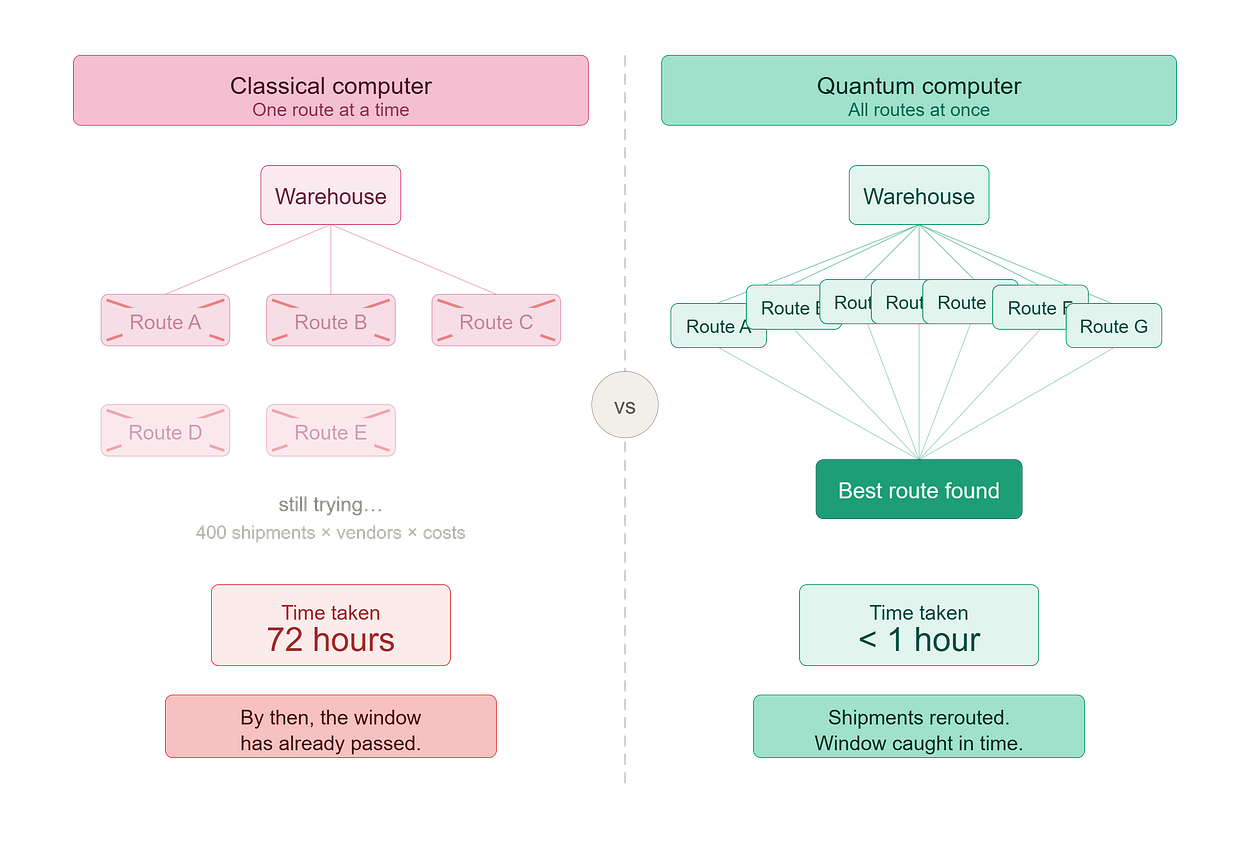
A pharmaceutical company needs to reroute 400 shipments overnight because one supplier just shut down. Their SAP system starts recalculating factoring in warehouse capacity, freight costs, customs rules, alternate vendors. It takes 72 hours to get a reliable answer.
By then, the window has passed.
That’s not a people problem. That’s a computing problem. And quantum computing is here to fix it.
What Is Quantum Computing Without the Jargon
Your regular computer works in binary, everything is a 0 or a 1, processed one step at a time.
A quantum computer uses qubits, which can be 0, 1, or both simultaneously. This means it can explore millions of possibilities at the same time, not one after another.
Think of it this way: a classical computer tries every route on a map one by one to find the fastest path. A quantum computer checks all routes at once and gives you the answer before you’ve finished your coffee.
Apply that to a supply chain with 50,000 variables and you start to see why SAP is taking this very seriously.
What SAP Is Actually Doing Right Now
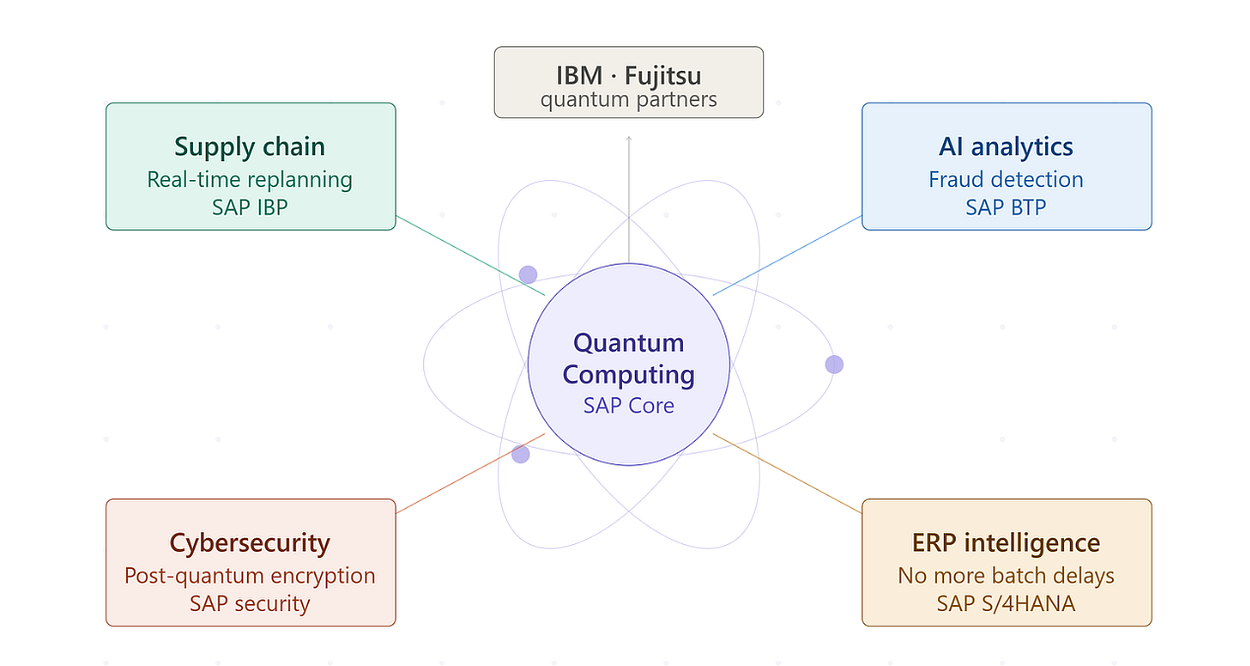
SAP CEO Christian Klein has put a stake in the ground: quantum computing will significantly reshape enterprise operations within the next three to four years. Specifically, he pointed to supply chain calculations that currently take a week being done in under an hour.
That’s not a vision statement. That’s a product roadmap signal.
SAP has already run real proof-of-concepts:
With IBM Quantum, SAP tested vehicle space optimization — how to load and route logistics as efficiently as possible. Processing times dropped dramatically.
With Fujitsu’s Digital Annealer Unit, SAP tested manufacturing scheduling and logistics planning. Results were strong enough to push the partnership further.
In May 2024, SAP expanded its IBM partnership to bring quantum computing and generative AI together inside SAP’s industry cloud. That’s a significant investment, not a side experiment.
Where It Will Hit First
Supply Chain Planning
A retailer running SAP IBP today can forecast demand and plan inventory but when conditions change suddenly (a port closure, a factory fire, a demand spike), rerunning the model takes time. Quantum speeds this up to near real-time. Disruptions get anticipated, not just reacted to.
AI and Predictive Analytics
SAP BTP already uses AI for fraud detection, demand forecasting, and risk modelling. Quantum amplifies this by running more simulations, faster, on bigger datasets. A bank using SAP could detect fraudulent transactions in seconds instead of hours. A manufacturer could run 10,000 demand scenarios overnight instead of 200.
Cybersecurity (The One Nobody Talks About Enough)
Most enterprise encryption today relies on Maths problems that take classical computers centuries to solve. A quantum computer could crack them in minutes. SAP security professionals need to be preparing for post-quantum encryption now, not when the threat arrives.
What This Means for SAP in the Next 10 Years
By 2035, the realistic picture looks something like this:
Batch processing in SAP S/4HANA largely disappears. Real-time ERP decisions replace overnight runs.
AI in SAP BTP becomes genuinely predictive: not just “here’s what happened” but “here’s what will happen and here’s what to do.”
Post-quantum encryption becomes standard across all SAP landscapes, especially in finance and healthcare.
What SAP Consultants Should Focus On
Supply chain and IBP consultants — quantum-enhanced forecasting is coming directly to your module. Get familiar with how SAP IBP’s planning models will evolve and how to translate quantum outputs into business decisions clients can act on.
SAP BTP and AI consultants — the intersection of quantum and generative AI is where SAP is spending money right now. Understanding how quantum accelerates AI model training puts you ahead of most of the market.
Security and basis consultants — post-quantum cryptography should already be on your reading list. This expertise is rare and will be in heavy demand as SAP systems begin migrating to quantum-resistant standards.
What Businesses Should Do Today
You don’t need a quantum computer yet. But a few things are worth doing right now:
Clean up your data architecture. Quantum-powered tools work best when data is structured and reliable. Messy data is still messy at quantum speed.
Review your encryption standards. Know what you’re using and whether it’s on the list of algorithms being phased out as post-quantum standards take hold.
Hire consultants who think forward. Not everyone needs to be quantum-native, but having people on your team who stay close to SAP’s roadmap is worth a lot.
Quantum computing is not a future concept. SAP is already building with it, partnering around it, and mapping it into upcoming product releases.
The businesses that pay attention now will adapt smoothly. The ones that wait will be catching up at speed.
And for SAP consultants, the ones who understand both the technical shift and the business impact will be the ones clients call first.
The door is open. Worth walking through now rather than later.
Want to know how quantum computing affects your SAP hiring strategy or technology roadmap? Let’s have a conversation.